Working Class 1810s
Welcome back to blog posting! (Maybe! I'm going to try to be better about blogging again. Got to fight the ever-increasing AI malarkey. My stuff may not be polished and pretty all the time but you can be damn sure I really took the photos and am writing all this out myself!)
.
This summer I made an 1810s working class outfit, and finally got around to taking pictures of it in my backyard, since I don't know when I'll get a chance to take pictures in a nicer setting! The overgrown garden beds work, I guess. Accidentally color-coordinated with the squash blossoms, very festive for fall.
.
Originally I started putting together this outfit with the idea of wearing it to interpret at a local historic site in South Jersey; that didn't work out, but I figured I might as well finish the outfit up and document it! The site interprets the house and small surrounding area as it existed during the 1810s, when it was a rural farm owned by a Quaker family. The interpreter role wouldn't involve anything more strenuous than walking up and down stairs and dealing with children, but one of the things I really enjoy about historic interpretation is the "how did they do that in those clothes?"...so if I'm making working class clothing I want to see how easy it is to actually do physical labor in said clothing.
Not that I did anything crazy in these clothes, but I did some weeding around the garden, picked some tomatoes, inspected the runner beans, and ran up and down several flights of stairs!

Compare the 1812 fashion plate here to an illustration of working women in 1820s Amsterdam. While there are plenty of examples of working-class women in full-length gowns, the short gown and petticoat combination that's seen in the 18th century is also easily found illustrated as late as the 1820s. And why not? It's versatile and very comfortable! If made of cotton or linen, it's also easily laundered. As such, I decided this type of outfit would be quite plausible for someone living on a small farm in New Jersey in the 1810s.
. 
Note: I made the c.1800 stays a few years ago and they have their own post! I like to demonstrate that yes, I CAN bend over in them...

Patterns used:
Cap: Country Wives British Regency Caps 1780-1820
Shortgown: Fig Leaf Patterns #219
Kerchief, apron, petticoats: my own patterns, drafted or draped by me
Huntin' for a punkin. (Rudely, there's only one and it's pretty pathetic.)
. 
Petticoat can be helpfully hoiked up to go diving amongst the raspberry canes!

Fabric/Materials used:
Cap: white handkerchief weight linen, moderately coarse weave (from my fabric stash).
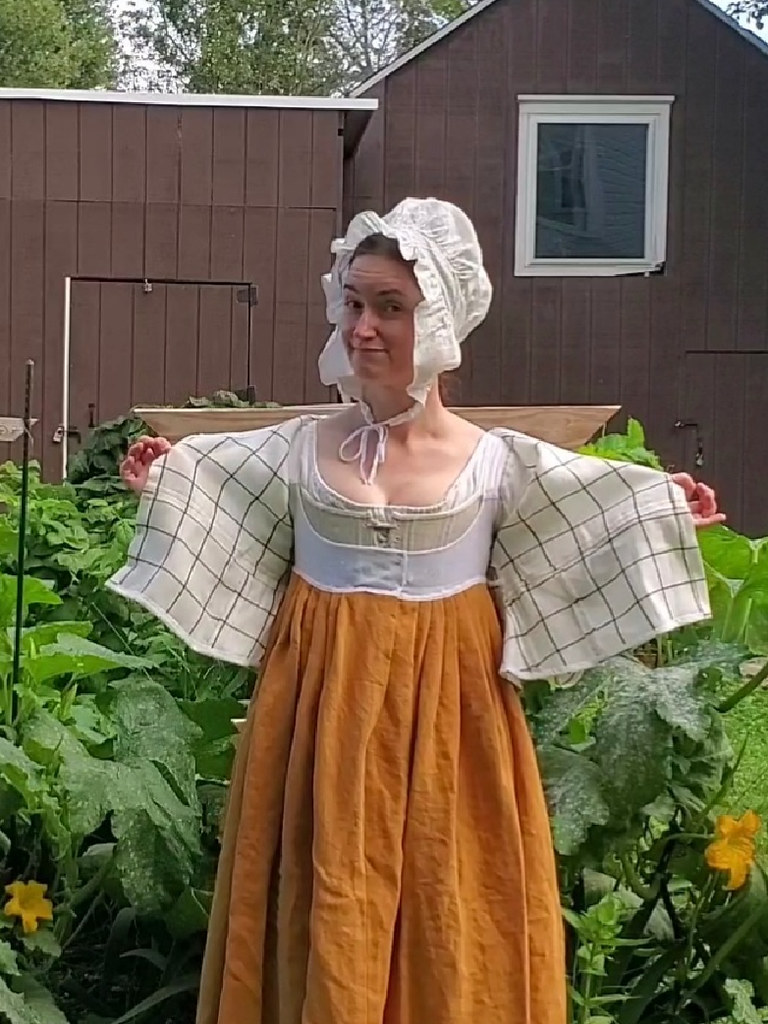
Short gown: Medium weight linen twill, white with a black windowpane woven pattern. (from Joanns, R.I.P.) Unlined.
Petticoat: Skirt of medium weight golden yellow linen from Fashion Fabrics Club, bodice of white linen scraps from my scrap bin.
Under-petticoat: White and navy lightweight linen check, also from Fashion Fabrics Club.
Apron & kerchief: several years old so I don't remember the source! Apron is likely the Joann's linen blend.
Construction:
Most of my outfit is hand-sewn (apart from shoes and stocking, of course!). Exceptions include:
- Possibly the apron pockets were sewn by machine? I don't remember...
- Short gown internal seams were sewn by machine; edge finishings and anything visible were done by hand.
- Shift was machine sewn and hand finished.
- Mitts are just old wool sweater sleeves cut up with thumb pieces sewn on (cheater mitts, but they were my first pair and I still wear them because they're cozy!).
- Stays are a mix of hand and machine sewn (see post link above).
Other garment notes:
The petticoat closes at center front with pins. An old-fashioned style by this point, but simple to wear and flexible with changes in size.
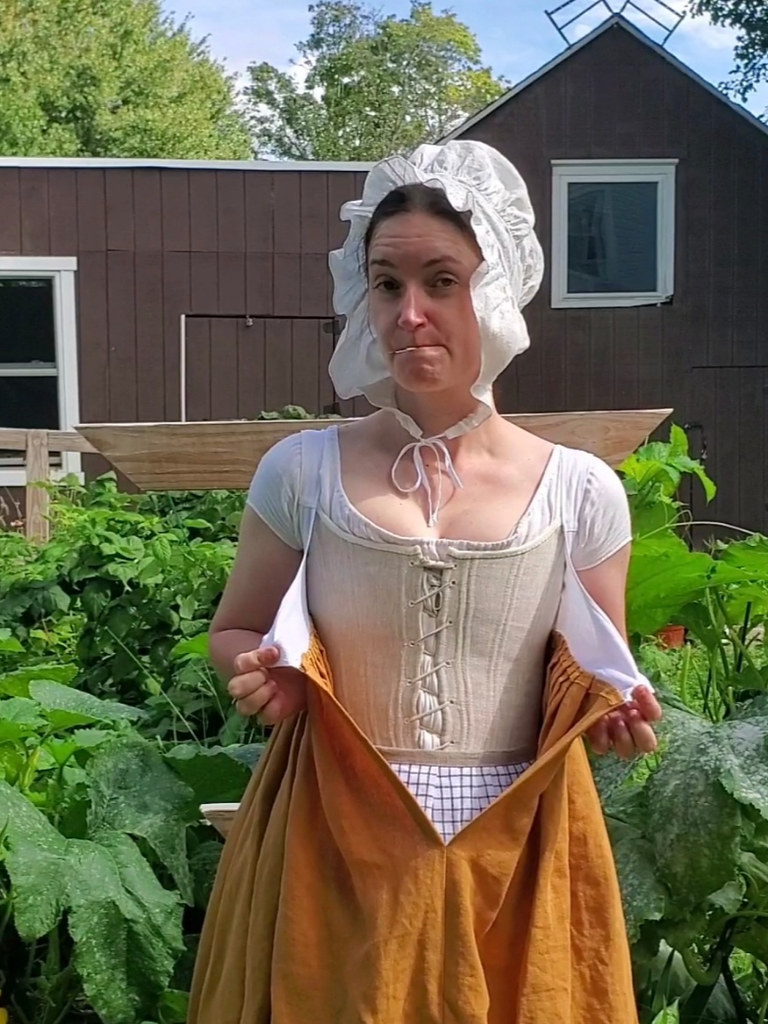
Speaking of old-fashioned style...look, pocket slits! I can easily wear my pair of separate 18thc pockets (they're on a tape and tie around the waist) with this outfit. Pockets are distinctly unfashionable during the "Regency" era, especially as the skirts tend toward shaped gores rather than rectangular panels. Not to mention the popularity of lightweight white fabrics doesn't lend itself to dress pockets! Pockets are, however, an extremely useful thing, and as this petticoat is made of simple rectangular panels and is pleated all the way around, it can hide pockets and pocket slits perfectly well.
. 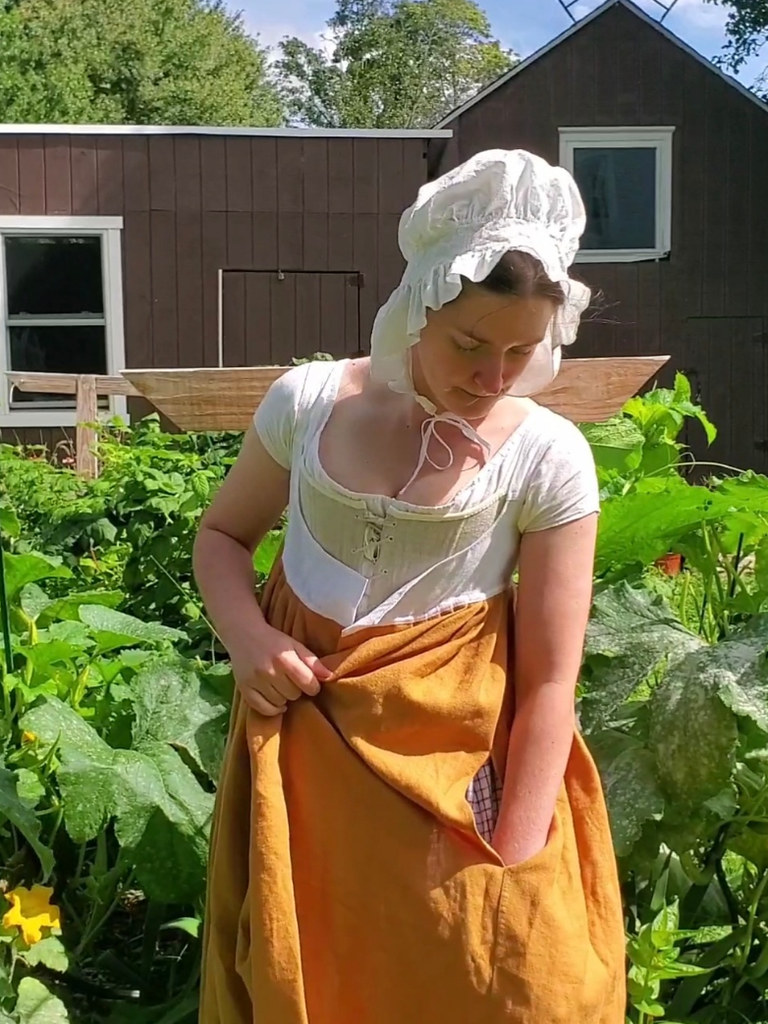
The short gown also closes at center front with pins. Again, old-fashioned but practical!
. 
The short gown pattern includes a drawstring at the high waist, under the bust to draw the garment in and keep it more fitted. I elected not to bother, partly because one of the piecing seams was right where the drawstring channel would have been (which would have added bulk) and partly because I don't think I'll ever be wearing this outfit without the apron, which holds the waist in just as well as a drawstring. Also partly because the windowpane check linen was loosely woven and kept unraveling as I worked with it and I was TIRED of it.
. 
And finally, the "underneath it all": checked linen petticoat, stays, and shift!
. 
.
Oh, this is beautiful! Your blog is new to me, got linked by someone on Facebook, and I'm happy to comment to let you know I saw and enjoyed this post - it's exactly what I love about sewing / costuming blogs. I also need to post more, and my problem is also partly the photos! :D
ReplyDeleteThank you! Yay, I'm so glad you enjoyed! I miss the widespread costume blogs, and I'm going to try and be better about posting more of my costumes here again. :)
DeleteFashion designing is a creative and exciting field that allows people to express their ideas through clothing, colors, fabrics, and unique styles. A good fashion designing course helps students learn about garment construction, sketching, pattern making, embroidery, and the latest fashion trends. It also develops creativity and practical skills needed to build a successful career in the fashion industry. Whether you want to become a fashion designer, start your own clothing brand, or work with a fashion house, learning fashion designing can open many opportunities. Choosing the right institute and gaining practical experience are important steps toward achieving your fashion career goals.
ReplyDeleteBest Interior Designing institute in Delhi NCR
German Language course in delhi / NCR
Best Fashion Designing institute in Delhi